
Cooling Tower Parts in Baton Rouge: How Vari-Flow Valves and Screens Improve Cooling Tower Performance
December 19, 2025
Balancing Water Flow in Cooling Towers with Vari-Flow Valves
January 8, 2026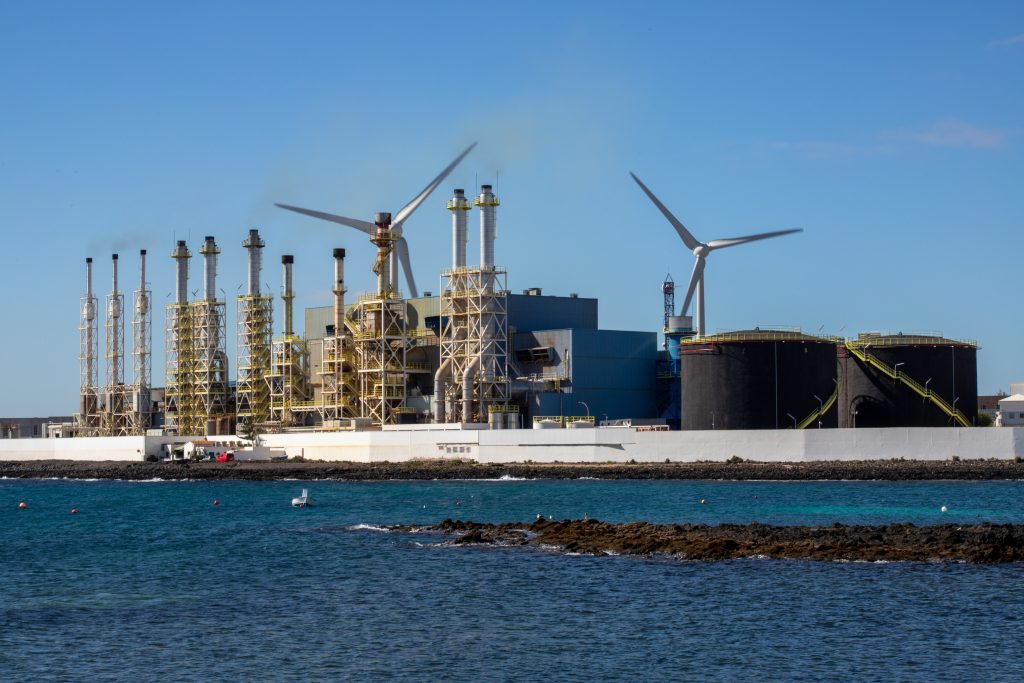
Originally published in 2022 and updated in 2025 to reflect current cooling tower system requirements and operational best practices.
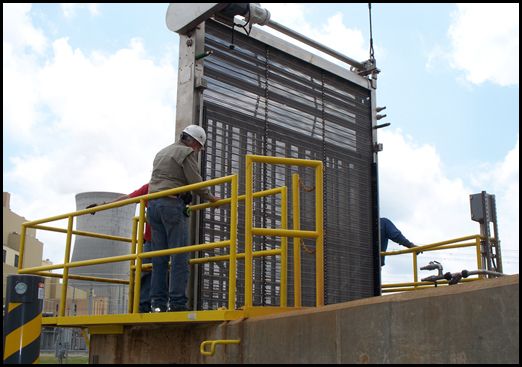
Traveling water screens used in saltwater environments must balance corrosion resistance, structural strength, and long-term reliability without increasing maintenance or mechanical wear. In coastal and marine cooling systems, material selection is critical, but performance is no longer driven by a single alloy choice. Instead, effective saltwater screen design focuses on pairing appropriate materials with engineered components to reduce corrosion, improve operation, and extend service life in harsh chloride environments.
Why Are Saltwater Applications Harder on Traveling Water Screens?
Saltwater environments accelerate corrosion and increase wear on moving components. Chlorides attack exposed surfaces, while debris loading and variable flow conditions add mechanical stress to screens and guides.
Traveling water screens in saltwater intake systems must withstand:
- Continuous chloride exposure
- Mechanical loading from debris and flow changes
- Long service intervals with limited maintenance access
These conditions require materials that perform well not only structurally, but also at wear points and guided interfaces.
EXPLORE OUR VALVES AND SCREENS SOLUTIONS
What Role Does Stainless Steel Play in Saltwater Traveling Screen Design?
Stainless steel is commonly used in traveling water screens for components that require structural strength, rigidity, and temperature tolerance. It performs well under load and maintains dimensional stability in demanding operating conditions.
However, stainless steel alone is not always ideal for every component. Its weight can increase mechanical wear and using it universally across a screen assembly can raise maintenance and installation demands. For this reason, stainless steel is most effective when applied selectively where strength is required, rather than throughout the entire system.
In more aggressive saltwater environments, higher-alloy stainless steels may be specified for critical components with elevated corrosion exposure.
Why Are Polymers Like UHMW-PE Used in Saltwater Traveling Water Screens?
UHMW-PE is frequently used in saltwater-traveling water-screen systems for wear components and guided-motion interfaces. Its lightweight, abrasion-resistant, and self-lubricating properties make it well-suited for applications where friction reduction and smooth operation are critical.
UHMW-PE offers:
- Reduced friction and smoother screen travel
- Improved abrasion resistance from debris contact
- Lower maintenance requirements
- Reduced overall system weight
While it does not provide the same structural strength as stainless steel, UHMW-PE excels in wear-focused applications.
Why Is Hybrid Material Design Preferred in Saltwater Cooling and Intake Systems?
No single material provides optimal performance across all operating conditions. Hybrid material designs combine the structural strength of stainless steel with the low-friction, wear-resistant benefits of UHMW-PE to improve overall system reliability.
This hybrid approach:
- Reduces mechanical wear at contact points
- Improves operational smoothness
- Minimizes lubrication and maintenance needs
- Extends service life in corrosive environments
This same design philosophy is used across our cooling tower valves and traveling water screens, where material selection is based on function rather than uniform construction.
How Does Hybrid Design Improve Long-Term Traveling Screen Performance?
By applying stainless steel where structural integrity is required and UHMW-PE where wear and movement occur, traveling water screens can maintain performance while reducing long-term maintenance costs.This approach limits corrosion exposure at vulnerable points and improves operational consistency over time.
Hybrid material strategies support:
- Reliable operation in saltwater intake systems
- Reduced downtime and service intervention
- Improved lifecycle performance
How Are CTVS Traveling Water Screens Engineered for Saltwater Applications?
CTVS traveling water screens are engineered using application-specific material selection and hybrid component design. By balancing corrosion resistance, mechanical strength, and wear performance, these systems are designed to operate reliably in saltwater environments while minimizing maintenance and extending equipment life.
Reliable performance in saltwater systems depends on engineering decisions, not material extremes. By applying hybrid material strategies across both cooling tower valves and traveling water screens, CTVS designs equipment that resists corrosion, reduces mechanical wear, and minimizes maintenance in harsh chloride environments. This application-driven approach delivers consistent operation, longer service life, and greater reliability for saltwater cooling and intake systems.